
<!-- wp:paragraph -->
<p><strong>Meta description:</strong> How to know when to replace your AC unit in Florida, age, the 5,000 rule, SEER ratings, and real replacement costs. Get a free assessment from Infinity Legacy.</p>
<!-- /wp:paragraph -->
<!-- wp:paragraph -->
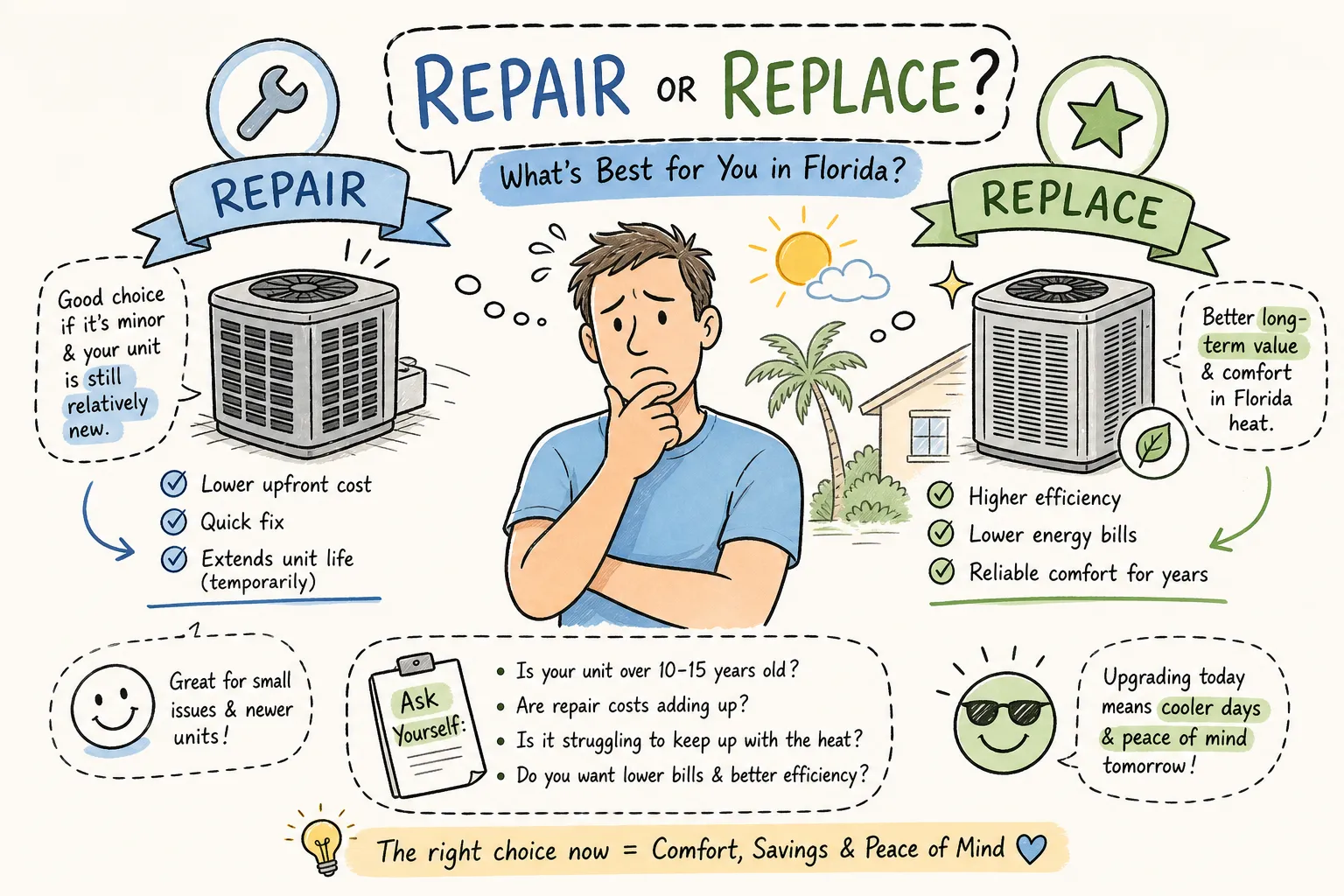
<p>Picture this: it's July in Florida, your AC dies on a Tuesday, and a technician hands you a $900 repair quote on a unit that's already 12 years old. Your gut says something is off, but you're not sure whether to approve the repair or finally pull the trigger on a new system. That hesitation is completely reasonable, and it's a conversation the team at Infinity Legacy has with Florida homeowners every single week.</p>
<!-- /wp:paragraph -->
<!-- wp:paragraph -->
<p>Knowing how to tell when to replace your AC unit in Florida is harder than it sounds. The repair-or-replace question hits differently here than it does anywhere else in the country. Florida's subtropical climate is genuinely brutal on HVAC equipment. Year-round operation, relentless humidity, and hurricane-season stress all add up to a system that wears out faster than national averages suggest. Making the wrong call costs real money, whether you overpay for repairs on a unit that fails two months later or replace a system that had years of reliable service left.</p>
<!-- /wp:paragraph -->
<!-- wp:paragraph -->
<p>This article walks through the exact framework used to make that call with confidence: Florida-specific lifespan data, the 5,000 rule, SEER ratings, replacement costs, and the financial incentives that can make a new system more affordable than most homeowners expect.</p>
<!-- /wp:paragraph -->
<!-- wp:heading -->
<h2>Why Florida AC Units Wear Out Faster Than You'd Think</h2>
<!-- /wp:heading -->
<!-- wp:paragraph -->
<p>The national estimate of 15 to 20 years for a central air conditioner doesn't apply in Florida. The realistic AC lifespan here is 8 to 14 years, and that gap exists for one straightforward reason: your AC runs constantly. While a system in a northern climate logs roughly 750 to 1,200 operating hours per year, a Florida system racks up 2,000 to 2,500 hours annually. That accelerated runtime grinds down compressors, capacitors, and fan motors years ahead of schedule.</p>
<!-- /wp:paragraph -->
<!-- wp:paragraph -->
<p>Location within Florida matters too. Coastal homeowners within a mile of the ocean often see failures as early as 8 to 12 years because salt air corrodes coils and condenser cabinets aggressively. Uncoated evaporator coils can perforate in as little as 5 to 7 years in heavy salt-exposure zones. Inland areas like Orlando, Gainesville, and Ocala are more forgiving, with systems reaching 12 to 15 years when properly maintained.</p>
<!-- /wp:paragraph -->
<!-- wp:paragraph -->
<p>Regardless of location, at Infinity Legacy we treat 10 years as the threshold where a unit enters its retirement phase. After that point, repair frequency and costs tend to accelerate sharply. Components don't fail in isolation, once a compressor starts struggling, the capacitor and fan motor usually aren't far behind.</p>
<!-- /wp:paragraph -->
<!-- wp:heading -->
<h2>How to Know When to Replace Your AC Unit in Florida: Air Conditioner Warning Signs</h2>
<!-- /wp:heading -->
<!-- wp:paragraph -->
<p>No single symptom tells the whole story, but certain patterns are reliable predictors of a unit that's done. If your system has needed repair more than twice in the past 12 months, that frequency matters more than the nature of any individual failure. Recurring breakdowns signal that multiple components are degrading simultaneously, and each repair simply buys a few more months before the next one.</p>
<!-- /wp:paragraph -->
<!-- wp:paragraph -->
<p>If your system uses R-22 refrigerant, it's almost certainly 15 to 20 years old. The federal government completed the <a href="https://www.epa.gov/ods-phaseout/homeowners-and-consumers-frequently-asked-questions" target="_blank" rel="nofollow">R-22 Freon phaseout</a> in 2020, ending all domestic production and import. The only supply left is reclaimed from salvaged systems. Prices have tripled in some Florida markets since the ban, and availability is not guaranteed. Any leak repair on an R-22 system is expensive today and may be impossible to source next year. That fact alone is often reason enough to replace.</p>
<!-- /wp:paragraph -->
<!-- wp:heading {"level":3} -->
<h3>Performance Symptoms That Signal It's Time to Replace</h3>
<!-- /wp:heading -->
<!-- wp:paragraph -->
<p>Watch for these air conditioner warning signs that point to a failing system:</p>
<!-- /wp:paragraph -->
<!-- wp:list -->
<ul class="wp-block-list">
<!-- wp:list-item -->
<li>Persistent hot spots or rooms that won't cool, even with the thermostat cranked down</li>
<!-- /wp:list-item -->
<!-- wp:list-item -->
<li>A sticky, clammy feeling inside the home despite the AC running, a sign the unit can no longer dehumidify properly</li>
<!-- /wp:list-item -->
<!-- wp:list-item -->
<li>Weak airflow from vents, pointing to a failing blower motor</li>
<!-- /wp:list-item -->
<!-- wp:list-item -->
<li>Short cycling, where the unit turns on and off in rapid bursts, wasting energy and stressing components</li>
<!-- /wp:list-item -->
<!-- wp:list-item -->
<li>Grinding, banging, or hissing noises, which signal compressor bearing failure or a refrigerant leak</li>
<!-- /wp:list-item -->
</ul>
<!-- /wp:list -->
<!-- wp:heading {"level":3} -->
<h3>Rising Utility Bills</h3>
<!-- /wp:heading -->
<!-- wp:paragraph -->
<p>Rising utility bills without any change in usage are another reliable signal, and one Florida homeowners often overlook. When a system is on its way out, it works harder to deliver less cooling. That inefficiency shows up directly on your electric bill every month, with many homeowners reporting gradual increases of 15 to 25 percent before a final breakdown. If your bills have been creeping up and nothing else in the home has changed, the AC is likely the culprit.</p>
<!-- /wp:paragraph -->
<!-- wp:heading -->
<h2>The 5,000 Rule: The Clearest Way to Make the Call</h2>
<!-- /wp:heading -->
<!-- wp:paragraph -->
<p>The 5,000 rule gives you a fast, math-based answer to the repair-or-replace question. Multiply the unit's age in years by the cost of the repair being quoted. If the result exceeds $5,000, replacement is the financially smarter move. If it falls below $5,000, the repair is likely worth doing.</p>
<!-- /wp:paragraph -->
<!-- wp:paragraph -->
<p>Here's how it plays out in practice. A 12-year-old unit facing a $500 capacitor replacement scores 6,000 on the rule, which puts it firmly in replacement territory. A 3-year-old unit with the same repair scores 1,500, which is clearly worth fixing. The formula works because it accounts for both the cost of the repair and the remaining useful life of the unit at the same time.</p>
<!-- /wp:paragraph -->
<!-- wp:paragraph -->
<p><strong><a href="https://dunedinrefrigeration.com/blog/understanding-seer-ratings-how-to-choose-an-energy-efficient-ac-in-florida/" target="_blank" rel="nofollow">A SEER rating upgrade</a> adds a second layer to the decision.</strong> If the existing unit runs below 14 SEER, typical of anything installed before 2015, the energy savings from upgrading to a modern 17 to 18 SEER2 system are substantial enough to accelerate the math further. Replacing a 10 to 12 SEER unit with an 18 SEER2 system can realistically cut cooling costs by 35 to 45 percent, which translates to $840 to $1,344 per year on a typical Florida utility bill. A unit that fails the 5,000 rule and runs at low efficiency is essentially paying you twice to replace it: you avoid the repair cost and immediately start cutting monthly energy bills.</p>
<!-- /wp:paragraph -->
<!-- wp:heading -->
<h2>Florida-Specific Factors That Tip the Scales Toward Replacement</h2>
<!-- /wp:heading -->
<!-- wp:paragraph -->
<p>Florida's climate means the AC never gets an off-season. A system that might coast through its 15th year in Minnesota may be structurally exhausted by year 11 in Tampa or Jacksonville. High humidity forces the AC to function as a dehumidifier as well as a cooling unit, putting extra strain on the evaporator coil and blower motor. When those components start failing, the home feels humid and uncomfortable even when the thermostat reads 72°F.</p>
<!-- /wp:paragraph -->
<!-- wp:paragraph -->
<p>For homeowners near the coast, salt air is an invisible accelerant. Communities like Palm Coast, Daytona Beach, and Melbourne sit in zones where uncoated coils can perforate years ahead of schedule. <strong>If a repair quote involves the coil on a coastal unit older than 8 years, that money is almost always better applied toward a <a href="https://infinitylegacybuilders.com/services/hvac" target="_blank">new system with epoxy-coated coils</a>.</strong> The repair solves today's problem while the salt air creates the next one.</p>
<!-- /wp:paragraph -->
<!-- wp:paragraph -->
<p>Timing also matters in a practical sense. The best months to schedule an AC replacement in Florida are mid-September through November and April. Summer replacements, especially July and August, cost 10 to 20 percent more and often come with two to three week lead times as contractors work through emergency calls. Planning a replacement during the shoulder season gets you better pricing, faster installation, and a team that isn't rushing between urgent jobs.</p>
<!-- /wp:paragraph -->
<!-- wp:heading -->
<h2>What AC Replacement Costs in Florida and How to Shrink That Number</h2>
<!-- /wp:heading -->
<!-- wp:paragraph -->
<p>Understanding the cost to replace an air conditioner in Florida helps you budget realistically before you're stuck making a decision under pressure. For a typical 3-ton home in 2026, <a href="https://buildpriced.com/cost/hvac" target="_blank" rel="nofollow">installed replacement costs</a> break down by efficiency tier:</p>
<!-- /wp:paragraph -->
<!-- wp:list -->
<ul class="wp-block-list">
<!-- wp:list-item -->
<li><strong>Code-minimum 14.3 SEER2:</strong> $6,500, $10,500</li>
<!-- /wp:list-item -->
<!-- wp:list-item -->
<li><strong>Mid-tier 15, 16 SEER2:</strong> $8,500, $12,000</li>
<!-- /wp:list-item -->
<!-- wp:list-item -->
<li><strong>Efficient 17, 18 SEER2:</strong> $10,500, $14,000</li>
<!-- /wp:list-item -->
<!-- wp:list-item -->
<li><strong>Premium variable-speed 20+ SEER2:</strong> $13,000, $18,000</li>
<!-- /wp:list-item -->
</ul>
<!-- /wp:list -->
<!-- wp:paragraph -->
<p>If ductwork is deteriorated or undersized, add $4,500 to $9,500 for a full duct replacement. That's often worth doing at the same time rather than straining new equipment with old ducts.</p>
<!-- /wp:paragraph -->
<!-- wp:paragraph -->
<p><strong>Several incentives can take a meaningful bite out of that number.</strong> The federal Section 25C tax credit currently offers up to $2,000 for qualifying heat pump upgrades and up to $600 for high-efficiency central AC systems. Florida utility rebates add more on top: <a href="https://www.fpl.com/save/programs/ac-rebate.html" target="_blank" rel="nofollow">FPL offers a $200 instant rebate</a> for systems at 15.2 SEER2 or higher, Duke Energy rebates range from $300 to $1,000 depending on efficiency tier and equipment type, and OUC programs offer additional credits for qualifying installs.</p>
<!-- /wp:paragraph -->
<!-- wp:paragraph -->
<p>The HEAR and HOMES state rebate programs, administered through FDACS, are rolling out in 2026 for eligible Florida households and could provide substantial rebates on qualifying installs on top of federal and utility incentives. The programs are income-tiered, so households under 150 percent of the area median income may qualify for the most significant benefits. Confirming your eligibility before signing a contract is worth the 10 minutes it takes.</p>
<!-- /wp:paragraph -->
<!-- wp:heading -->
<h2>How to Know When to Replace Your AC Unit in Florida: Getting an Honest Assessment</h2>
<!-- /wp:heading -->
<!-- wp:paragraph -->
<p>Once you've run through the age, the 5,000 rule, and the warning signs, the next step is getting eyes on the actual system, not just the symptom that triggered the service call. Before committing to either a repair or a full replacement, the most valuable move is a proper evaluation of the system's real condition. A thorough assessment should cover the unit's age and refrigerant type, the condition of the evaporator coil, ductwork integrity, and an honest efficiency projection for the home's size and layout. That information gives you a real foundation for the decision instead of a reactive response to a single repair quote.</p>
<!-- /wp:paragraph -->
<!-- wp:paragraph -->
<p>Infinity Legacy provides free assessments across Florida with no obligation and no sales pressure. As a licensed multi-trade contractor (CGC1540795) handling roofing, HVAC, <a href="https://infinitylegacybuilders.com/blog/signs-you-need-impact-windows-florida" target="_blank">impact windows</a>, and <a href="https://infinitylegacybuilders.com/blog/kitchen-bathroom-remodel-roi-florida" target="_blank">remodeling</a>, the team evaluates the full picture of your home rather than treating the AC in isolation. For homeowners who decide replacement is the right call, PACE financing at $0 down makes a new system financially accessible now rather than years from now, with repayment structured through the property tax bill and no traditional credit requirement.</p>
<!-- /wp:paragraph -->
<!-- wp:paragraph -->
<p>The goal of every assessment is straightforward: give you the information you need to make the right call for your home and your budget, whether that answer is repair, replace, or wait.</p>
<!-- /wp:paragraph -->
<!-- wp:heading -->
<h2>Making the Call with Confidence</h2>
<!-- /wp:heading -->
<!-- wp:paragraph -->
<p>The HVAC replacement timing decision comes down to four checkpoints. First, check the age: 10 years is the threshold in Florida where a unit enters its retirement phase. Second, apply the 5,000 rule to any repair quote on the table. Third, factor in the SEER rating and your utility bill trend. Fourth, weigh Florida-specific accelerants like humidity load, coastal salt exposure, and R-22 refrigerant status.</p>
<!-- /wp:paragraph -->
<!-- wp:paragraph -->
<p>Waiting too long is consistently the most expensive decision. A failing unit working overtime to maintain temperature costs money every month on your electric bill while still moving toward a breakdown. When it finally fails in the middle of a Florida summer, your options narrow and your costs go up.</p>
<!-- /wp:paragraph -->
<!-- wp:paragraph -->
<p>If your unit is over 10 years old, or you're sitting on a repair quote that made you pause, knowing how to evaluate when to replace your AC unit in Florida can save you thousands. A free assessment from Infinity Legacy is the logical first step. You'll leave with a clear picture of your system's condition, what it's actually costing you month to month, and what your best options are. <strong>Request your free assessment at infinitylegacy.com or call us directly.</strong> No pressure, just straight answers from a team that works through this decision with Florida homeowners every day.</p>
<!-- /wp:paragraph -->
<!-- wp:html -->
<!-- /wp:html -->
Back to Blog
When to Replace vs. Repair Your AC Unit in Florida
Learn when to replace vs. repair your AC in Florida using age, the 5,000 rule, and SEER ratings. Get a free assessment from Infinity Legacy.
July 19, 2026By Infinity Legacy Builders Team
$0 Down · No Traditional Credit Required
Start Your Project With $0 Down Financing
Roofing, HVAC, impact windows & doors, and qualified remodeling upgrades may be eligible for PACE financing — repaid through your property tax bill, with no traditional credit requirement.
- $0 down options available
- No traditional credit requirement
- Long-term repayment options
- Available for qualified upgrades
- Energy & storm-protection projects
- Fast qualification support